Cactus Charlie
Well-known member
- Joined
- Mar 1, 2025
- Posts
- 552
- Type aircraft owned
- CCX-2000 (FX-3)
- Base airport
- KDVT
- Ratings
- Commercial ASEL, ASES, AMEL, glider. CFI glider, ASE, Instrument.
Follow along with the video below to see how to install our site as a web app on your home screen.
Note: This feature may not be available in some browsers.
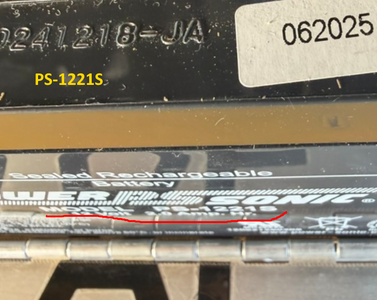
I think @Cactus Charlie 's point is that there would be demand (at least from the folks on this forum) for a safe, proven drop-in replacement for the PowerSonic battery, with minimal required alterations. While I wouldn't go so far as to say that cost would be "no issue," IMO it's fair to say that we understand that a robust, improved solution is gonna cost more (at least I do).this battery right ? dims 151 x 20 x 89h, 1.2Ah@1C discharge
1. have capacity greater than '3 amp hour'... 4ah
at a1.5A discharge rate, must use a LFP chemistry , no bms, just a balancer
2, have a loaded terminal voltage of at least 10 V after 1 hour discharge at 1.5A,ok
3. match the dimensions and terminal type of the Panasonic PS -1221S confirm this .. I think you can change the terminals from spade to another quick connect
4. draw no more than 5 A from a 14.2 V supply at any state of discharge. most likely
5. last at least 5 years including long periods of storage with no charging, probably
NOW,... how much would this be priced at ????? what would people be willing to pay ? certainly not even close to the $30 a ps1221 costs...
I did recently purchase an EarthX ETZ5G and intend to run some tests with it as a substitute for the AGM battery.
That is from what charge source? An optimate? I'm curious if you put this in your plane, discharged, and tested the current the plane supplies over its charge path what the amps would read. In my case it never exceeded 1.4A if I recall. Granted, it wasn't discharged but I don't know the current setup is going to supply what you're seeing from a dedicated charger such as a 10A Optimate like mine.The initial charge current after this discharge test was over 9 A. Charge current was still over 6 A after 13 minutes but was close to zero after 30 minutes.