Welcome to Flightinfo.com

  • Register now and join the discussion
  • Friendliest aviation Ccmmunity on the web
  • Modern site for PC's, Phones, Tablets - no 3rd party apps required
  • Ask questions, help others, promote aviation
  • Share the passion for aviation
  • Invite everyone to Flightinfo.com and let's have fun

Question Manifold pressure first or Propeller first - after takeoff?

Welcome to Flightinfo.com

  • Register now and join the discussion
  • Modern secure site, no 3rd party apps required
  • Invite your friends
  • Share the passion of aviation
  • Friendliest aviation community on the web

Neal

Forums Chief Pilot
Staff member
Joined
Oct 31, 1996
Posts
1,637
Type aircraft owned
Carbon Cub FX-3
Base airport
KFCI
Ratings
COMM, IFR, MEL, SEL
So you takeoff, prop and manifold are full forward, 2700 RPM check. Now you want to bring the prop back to 2500 RPM to reduce noise, etc.

Do you bring the manifold back first, such as to 25 inches? Or do you leave the manifold full forward and bring the prop back to 2500?

Story:

I took a fellow cub owner flying with me a few months ago and he noticed I was bringing the prop back first. "Aren't you supposed to pull manifold before prop?" Hmm, I thought, yeah, so I changed. I knew this and I'm not sure why I was doing it this way.

So I go to a seminar at OSH 2024 with Mike Busch (Savvy Aviation) giving a talk, can't remember the name of the seminar but it was good although I tend to avoid his stuff as they are so long and chatty. But this one was good AND one thing he mentioned is to leave the manifold full forward after takeoff and bring the prop back such as above. The reason is during climb if you reduce engine power it will cause the engine to work harder and end up running hotter. Hmmm, maybe that's what I had heard in the past and why I was doing it the way I was.

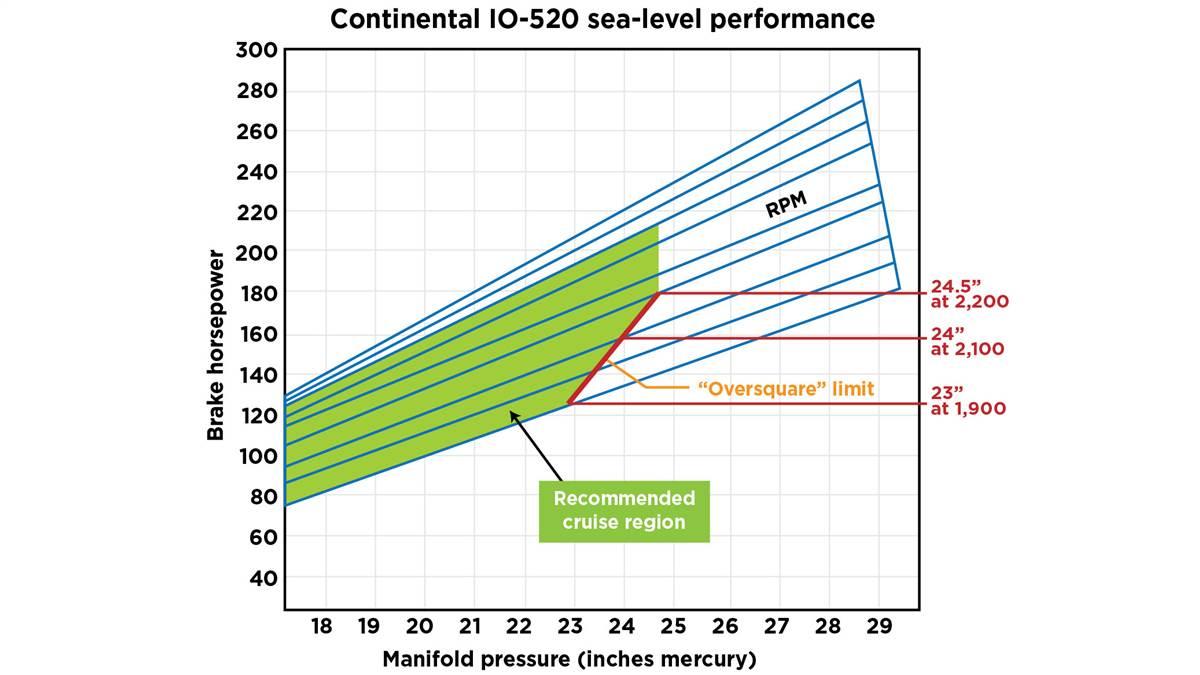
So now I'm wondering which to do. I've also heard about and researched flying "over squared" which is an interesting concept and you can see that with engines such as mine, a Lycoming IO-360 (essentially) you can run it 5 inches over squared, i.e. 25 inches 2000 rpm for example.

So what is your power reduction technique on climbout post takeoff? Or any climb for that matter?
 
Interesting Neal. I've been out of pistons for a minute and know zero about your plane. But I remember over squared as being bad and a way to kill an engine that was designed for it.

Found this video from Savvy on Over Squared flying


Interesting, I pull power back first. I guess because of the over square idea drummed into my head. Which brings me to another tangent - How do you do it in Europe, metric system and all?
 
Follow Savvy. We were all taught wrong back in the day, and unfortunately that has been long lasting. There is no need to reduce manifold pressure before bringing back the prop to 2500. There is also nothing wrong with leaving full power until TOC.

My first employer (US Check) back in 1993 corrected me on the bad habit of setting power square while flying Barons and Aerostars.
 
Taught wrong? Maybe. Misunderstood is more likely.

All one has to do is look at an airplane manual, even an old one, for a constant speed prop to know that “over square” is only a problem when they are way off.

Prop first to increase/MP first to decrease is the same. It’s to avoid things getting out of whack if you are going to reduce or increase both. It has nothing to do with maintaining climb power while reducing prop 100-200 RPM for noise and vibration. Never really did.
 
When I first started flying constant speed props, like most of us, I was taught to always fly under squared. But since reading Mike Busch's books I'll typically fly over squared unless I'm flying equal. In either case manifold/RPM was always within 2 in/2000rpm.

When reducing power after climbing out, I'm still walking back power and rpm about the same or power slightly before rpm, until I get to around 24/24000, then I'll set it what I want for cruise.
 
One also has to remember the state of metallurgy when the first constant speed propellers arrived…operators were amazed that the “new” Wright Whirlwinds were running 250 hours between failures!

Aviation has always demanded the most from the materials used. Even as recently as the development of the IO-520, those cylinders heads have been improved to decrease their notorious cracking issues. In the 1920’s and ’30’s the cylinder heads were nowhere near as well made as they were by the time WWII started. They were actually quite fragile. Some heads were bolted onto a flange on the cylinder rather than screwed onto it like they are now. I was helping with a 5 cylinder Kinner engine that had blown the soft copper head gasket at a flyin. On advice from one of the guys providing tools we took the head to an old, grey haired machinist (this was a long time ago and I was still in my 20’s!) and thank God we did.

The old gentleman looked over the casting and said “Well, that’s why the gasket blew-those old casting were pretty porous and not very good. Threads are pulling on that stud, look close…"

Turns out that wasn’t the first time-that gasket had blown twice before and no one had seen the ever so slight indication of where the stud was pulling out of the casting. As far as anyone know it had never been over torqued but on an engine that was then 65 years old or so, who knows?

Oh, and then throw in a turbosupercharger with a less than stellar wastegate control system that would surge and bend the MP needle on the high stop peg when some ham-fisted stick monkey stuffs the throttle to the firewall! Even the relatively robust V-12 Allison’s wouldn’t put up with that crap!

And when-as they said of the B-29 and later the KC-97/Stroatoclunker-you had “One to lose, one to sweat over and two to get home on.” the FE’s worked really hard to keep those big radials within limits...

Of course we have new challenges today-like externally powered electronic ignition systems that require external emergency backup batteries-Angels and ministers of grace defend us! Well, let the smoke out of one of the Chinesium diodes in the pos and no amount of backup batteries is gonna help...

Gimme a pair of Bendix Mags any day!!!
 

Latest resources

Back
Top Bottom