Welcome to Flightinfo.com

  • Register now and join the discussion
  • Friendliest aviation Ccmmunity on the web
  • Modern site for PC's, Phones, Tablets - no 3rd party apps required
  • Ask questions, help others, promote aviation
  • Share the passion for aviation
  • Invite everyone to Flightinfo.com and let's have fun

Criminalization of Pilots: Are you next?

Welcome to Flightinfo.com

  • Register now and join the discussion
  • Modern secure site, no 3rd party apps required
  • Invite your friends
  • Share the passion of aviation
  • Friendliest aviation community on the web

Rez O. Lewshun

Save the Profession
Joined
Jan 19, 2004
Posts
13,422
It is growing.. from the Airlines to GA...

After the Accident

From ultimate freedom to incarceration

By Dave Hirschman

  • Mark Strub fought against panic as his Stearman sank, inverted, into a broad, slow-moving river. His hands groped for the pair of latches that could release him from his seatbelt harness. But the five-point harness pinned him firmly against the metal seat, where he was also bound to a 30-pound parachute.
Even though the cool water was less than six feet deep, Strub (pronounced stroob), an experienced scuba diver, was trapped, descending into darkness, and running out of time.
“I’m going to drown,” he admitted to himself. “If I can’t get loose right now, I’m actually going to drown.”
His thoughts also turned to his passenger, Kimberly Reed, whom he’d met less than an hour before. She was strapped into the biplane’s front seat, an arm’s reach away.
Was she stuck in the waterlogged airplane, too?
Strub finally unbuckled his harness and swam free from the upside-down airplane that remained partially submerged in the river. He lunged forward to the front cockpit to help his passenger. To his horror, he saw that the biplane’s top wing had struck a submerged rock. The wooden structure was smashed downward and aft, blocking access to—or escape from—the airplane’s front cockpit.
A broad-shouldered, 180-pound carpenter, Strub, 45, recalled stories of people in emergencies being imbued with superhuman strength. But his frantic efforts couldn’t budge the saturated, 3,000-pound Stearman. He rushed to the river’s edge and ran to summon help. Then he sprinted back to the scene of the accident—a normally tranquil, idyllic branch of the Wisconsin River near the mill town of Wisconsin Rapids in the rural, central part of the state.
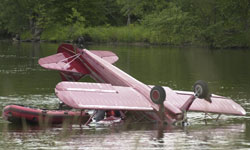
accident0807a.jpg
Photo courtesy Wisconsin Rapids Tribune
Rescue workers followed him to the accident site, and they immediately noticed another danger. Strub’s low-flying airplane had clipped a cluster of power lines that supplied electricity to a nearby paper mill—and those wires were submerged in water. Anyone who stepped into the river was at risk of electrocution.
With each passing moment, Strub realized any chance of saving Reed was slipping away.
“That’s when I lost hope,” said Strub, a private pilot with about 500 flying hours. “There was no way she could still be alive.”
Facts not in doubt

This year, Strub became the first U.S. pilot jailed for a domestic aircraft accident. He pleaded guilty to reduced charges of negligent operation of a motor vehicle and disorderly conduct and was sentenced to 30 days in jail, 150 days home confinement, fines, court costs, and two years probation during which he won’t be allowed to fly.
He wears a pair of electronic monitoring bracelets, isn’t allowed to consume alcohol (even though alcohol played no role in his accident), and can only leave home to attend work. A divorced father of three girls, Strub also awaits a civil trial that could bankrupt him and lay claims to future earnings.
He has been vilified as a criminal, and Reed’s grieving family has called him a murderer.
His case fits an international pattern of criminalizing aviation accidents that dates back at least to 1992 when a French air traffic controller and several Airbus officials were charged in criminal court following an A320 crash in Strasbourg. In 1996, three SabreTech mechanics were charged for improperly loading oxygen canisters on a ValuJet DC-9 that caught fire and crashed in the Everglades. In 2000, two former Aerospatiale officials were charged with criminal counts related to the Concorde crash in Paris. A Swiss court convicted four air traffic managers following a 2002 midair collision between a DHL Boeing 757 and a Tupolev 154M, and two U.S. corporate pilots weren’t allowed to leave Brazil for two months in 2006 after a midair collision between their Embraer Legacy and a Boeing 737 over the Amazon. A Cape Air pilot was sent to jail for hiding a form of diabetes that would have disqualified him from airline flying.
Aviation safety experts fear criminalizing aviation accidents will decrease air safety over the long term by clamping down on the free flow of information that could help avoid future mishaps.
The facts surrounding Strub’s crash aren’t in doubt. Opinions vary, however, about whether his actions amounted to criminal conduct, or whether justice is served by sending him—or other general aviation pilots involved in aircraft accidents—to prison.
Wood County District Attorney Todd Wolf, the Wisconsin official who pressed charges against Strub, declined to comment for this story. But he told a local newspaper he would have pursued the case whether the fatal accident had happened in a car, motor-cycle, or boat.
“I have prosecuted (many) vehicle accidents resulting in death,” he said. “We see these cases in a lot of vehicles.”
As perfect as he could make it Strub inherited his fascination with biplanes from his father, a master craftsman who built two of his own—a Hatz biplane and a SkyBolt.
Strub established a successful carpentry business in the 1990s and earned a private pilot certificate in 2002. His first airplane was a Piper Colt, and then he bought a Luscombe to gain the tailwheel skills needed to fly biplanes, his real love.
He bought a 1941 Super Stearman in 2001 while still in flight training and, in the next year, rejuvenated the fabric and repainted every inch of the 450-horsepower airplane. When he finished, the once-ragged workhorse had been transformed into a gleaming, red jewel.
“I removed and sanded the wings and all the control surfaces,” he said. “I even polished all the stainless steel screws before I put them back on the airplane. I wanted everything to be as perfect as I could make it.”
Strub got dual instruction in his Stearman from a former crop duster, and he learned to fly basic aerobatics in it, too.
“I flew as much as I could—and by the summer of 2004 I had logged about 225 hours in the Stearman,” he said. “I was finally getting to the point where I felt like the airplane was part of me.
I could feel what the airplane was doing, and I could anticipate what it was going to do next. It was a really great feeling.”
Strub had a clean flying record with no accidents, FAR violations, or insurance claims before August 28, 2004, the date his flight ended so tragically a few miles from his home base at Alexander Field-South Wood County Airport.
Strub says he intended to share his passion for flight that day by giving rides in his open-cockpit airplane. The weather was perfect, his Stearman was in top mechanical condition, and he believed his preflight planning and safety precautions were exemplary.
Strub and his passenger both wore parachutes and, during the initial portion of their aerobatic flight, remained at relatively high altitudes—all in accordance with FAA regulations and prudence. Then, on the way back to the airport, Strub descended to treetop height and following the contours of the wide, curving Wisconsin River.
FAR 91.119 places no limit on how low pilots are allowed to fly over sparsely populated areas or open water, as long as they stay at least 500 feet from any persons or vessels and can glide to a landing in case of engine failure without “undue hazard to persons or property on the surface.”
An FAA investigator later cited Strub for “careless and reckless” flying, defining the river as a “congested area,” and said Strub violated minimum safe altitude rules that require pilots to fly at least 1,000 feet above or 2,000 feet horizontal distance from obstacles. Strub said he believed at the time of the accident he was flying over a portion of the river that was free of hazards.
“I thought I was over a section of the river that I knew well,” he said. “But as it turns out, I was a mile and a half upriver from that point—and I was following a different branch. I’d never intentionally fly over any section of river that I didn’t already know.”
 
We were underwater

Strub arrived at Alexander Field early on the day of his accident. The Children’s Miracle Network was hosting a balloon rally at the airport that day, and a large group of hot-air balloons lifted off shortly after dawn to take advantage of the clear skies, cool air, and light winds.
Strub skipped breakfast and got off the ground alone in his Stearman in time to watch the balloon spectacle from above. When he landed, airport visitors started asking for airplane rides—and Strub was glad to oblige. As a private pilot, Strub said he knew he couldn’t charge for the rides. But one rider insisted that Strub take a token payment of $8—a fact that would come back to haunt him. He said he thought he could accept the money as pro rata cost sharing. The FAA later disagreed, however, and faulted Strub for failing to have a commercial pilot certificate, 100-hour aircraft mechanical inspections, a drug screening program, and other requirements for professional scenic flying operations.
Kimberly Reed, 39, of Eau Claire, Michigan, came to the airport that morning with her husband, Kevin. The Reeds were on a family vacation with their children, and the couple inquired about a biplane ride for Kimberly.
Strub had planned on parking his airplane for the day. But after giving several flights, he didn’t want to disappoint an eager passenger.
“Aerobatic or straight and level?” he asked.
Aerobatic.
They strapped on parachutes, climbed to about 3,000 feet over the verdant countryside, and Strub performed a series of maneuvers: loop, roll, half-Cuban, and two hammerheads. That was enough for Reed who said she was beginning to feel queasy.
Strub let Reed handle the controls for a few moments as they began a long descending left turn toward the water. Following the meandering Wisconsin River would be a thrilling substitute for aerobatics, Strub thought, and the river’s course would point them back toward Alexander Field.
In his carpentry business, and charity work taking disabled kids for rides in horse-drawn sleighs, Strub said he strives always to “do a little extra” to exceed expectations. On this flight, a low-level river tour was the bonus.
“We were chatting on the intercom as we descended,” Strub said. “Everything was going just fine.”
A Stearman, even a big-engine model like Strub’s, typically travels at a relatively sedate 110 miles an hour in level flight. But the sensation of speed is magnified at lower altitudes—especially with ridges of towering pine trees nearby.
Strub followed the clear, boulder-strewn river, and he was about to start a climb when he saw the wires. A cluster of them stretched across the water at exactly his height suspended from 70-foot-tall poles on both banks. He pulled back sharply on the stick—but too late.
The sagging wires wrapped around the Stearman’s main landing gear, and Strub felt the powerful airplane decelerate as the wires stretched taut.
The Stearman pulled so hard that it snapped some of the wooden poles, but the thick cords didn’t break. They clung to the airplane with a deadly grip.
Strub kept pulling on the stick in a futile attempt to climb. Then the Stearman’s nose suddenly pitched downward. Looking ahead, he saw only the rushing river.
“I remember looking straight down,” he said. “And then we were underwater.”
Was she happy?

Strub doesn’t have nightmares about the accident. The images haunt him in daylight.
“I call them daymares,” he said, “and I don’t know what triggers them. I’ll be driving down a road or thinking about something else, and suddenly the entire scene pops into my head. I remember every detail. I relive it all the time. For the first four months afterward, I cried every day.”
The FAA revoked Strub’s private pilot certificate five months after the accident and barred him from flying for one year. Months later, he was told he was the target of a criminal investigation. He hired a lawyer, and the lawyer said not to do anything until he was charged with a crime. Soon, Strub was charged with vehicular homicide, a felony that carries a maximum sentence of 10 years in prison.
Strub returned to flying as a student pilot a little over a year after his certificate was revoked. He took the FAA knowledge test again and passed a second private pilot checkride. But flying had lost some of its magic.
“I always thought of flying as the ultimate freedom,” he said. “When the wheels left the ground, I felt like I was leaving my troubles behind. But after the accident, every flight reminded me, in some way, of the accident.”
Strub had been working on a commercial pilot certificate and planned to fly agricultural aircraft seasonally in North Dakota. But he dropped those plans. He also called Kevin Reed, Kimberly’s husband, on the phone weeks after the crash.
“I just wanted to express my sadness and regret for everything that had happened,” Strub said. “It was hard, very hard. But I wanted to apologize, even though I knew my words were inadequate. Nothing I could say would bring Kimberly back. I also told him that I would answer any of his questions.
“The one thing he wanted to know was whether Kimberly had been having fun in the moments before she died. Was she happy?”
There’s a reason

As Strub prepared for trial, he gained new confidence. To convict, a jury would have to find Strub had acted “with intent to cause damage,” or that injury or death “would probably result” from his actions. Strub believed he could show that the crash was purely accidental, and that he never would have flown low over the river if he thought he was putting his passenger, his airplane, or himself, in jeopardy.
Then, at the last minute, the district attorney offered an alternative.
Strub could plead guilty to two misdemeanors, negligent operation of a motor vehicle and disorderly conduct. He still faced the possibility of jail time—but the chance of a felony conviction and 10 years imprisonment would disappear.
Strub’s lawyer was driving to the courthouse for the start of the trial and negotiating the terms of the plea on his cell phone at the same time. With mixed emotions, Strub took the deal.
A judge sentenced him to 30 days in the nearby Wood County Jail. And being in jail, surprisingly, wasn’t as terrible as Strub had imagined. He maintained his business on work release, and he even made friends with fellow inmates, most of whom were serving drunk-driving sentences.
Strub still faces a civil trial that could impose lifelong financial penalties. But he said he’s looking forward to the future despite the uncertainty.
“All they can take is everything I own,” he said stoically. “I’ll always have sadness and remorse. I was the pilot in command, and the accident was my fault. If I had flown the entire flight above 1,000 feet, none of this would have happened.”
Strub said he’s endured some dark thoughts and brief periods in which he wished that his life had ended that day, too. But he’s received hundreds of cards and letters from fellow pilots and others, mostly strangers, who sympathize.
One of the writers was a person Strub knew well—his third-grade teacher. She was a World War II-era air traffic controller, and she wrote to tell him of the burdens she and her colleagues carry from fatal mishaps that took place on their watch more than a half-century ago.
Strub said he is bitter that the civil suit against him also names dozens of other people and organizations with little or no apparent connection to the accident. The Children’s Miracle Network is named in the suit as well as balloon rally organizers he says are blameless.
Strub also thinks of Kimberly Reed, his passenger, and he wonders what she thinks of him. (He says it in the present tense.) According to a coroner’s report, Reed probably died immediately when the Stearman struck the wires. Strub clings to the hope that she didn’t suffer.
“She seemed like a really kind person,” Strub said. “At some level, she must know that her death was an accident.”
The fact that he survived a crash that could so easily have ended his life also leads Strub to believe that he is alive for an as-yet unfulfilled purpose.
“There’s a reason I’m still here,” he says. “I don’t know what it is. But I’m absolutely sure there’s a reason.”
E-mail the author at [email protected].
 
Strub followed the clear, boulder-strewn river, and he was about to start a climb when he saw the wires. A cluster of them stretched across the water at exactly his height suspended from 70-foot-tall poles on both banks. He pulled back sharply on the stick—but too late.
This individual takes a trusting person along on a highly dangerous stunt in clear violations of both the FARs and common sense.

I tend to think that 30 days in jail was getting off pretty light.
 
“All they can take is everything I own,” he said stoically. “I’ll always have sadness and remorse. I was the pilot in command, and the accident was my fault. If I had flown the entire flight above 1,000 feet, none of this would have happened.”

Ladies and gentleman, I give you exhibit "a" in the upcoming civil trial.
 
He lost SA. He thought he was over an area of the river he knew... His actions weren't criminal.... poor judgement maybe... but not criminal.....
 
He lost SA. He thought he was over an area of the river he knew... His actions weren't criminal.... poor judgement maybe... but not criminal.....

"I thought she was 18"
"I thought that I had hit a deer instead of a kid"
"I thought that I wasn't drunk"
"I didn't think that I hit him that hard"
"I was just trying to scare him"
"I thought that it didn't belong to anyone"
"I thought that I could get away"
"I thought the road was straight"
"I thought that this car was safe at that speed"
"I thought I was going 55"
"I thought that sign didn't apply to me"
"I didn't know that this was a school zone"

Get it?

I'd say that MOST criminal actions are the result of poor judgment.
 
"I thought she was 18"
"I thought that I had hit a deer instead of a kid"
"I thought that I wasn't drunk"
"I didn't think that I hit him that hard"
"I was just trying to scare him"
"I thought that it didn't belong to anyone"
"I thought that I could get away"
"I thought the road was straight"
"I thought that this car was safe at that speed"
"I thought I was going 55"
"I thought that sign didn't apply to me"
"I didn't know that this was a school zone"

Get it?

I'd say that MOST criminal actions are the result of poor judgment.

No I don't get it... do you? Nothing you described is applicable...

If I rent a car in a town I've never been in... and I make a wrong turn and kill somone...an unfortunatel accident.... is that criminal....?

If grandma hits the gas insted of the brake and kills a boy... is that criminal?

Are you a lawyer?
 
Had he operated according to the rules and regulations, this would not have happened. The powerlines were suspended on poles 70 feet tall, he was at or below 70 feet. Either which way you slice it, that was too low.

He broke several FAR's, including the worst offense a pilot can do, careless and reckless. Yes, that one is often misused, but in this case, it is spot on.

Sorry Rez, ignorance and poor airmanship is not an excuse. The FAR's are written in blood, I guess he decided to add more.

Like someone esle said, I think he got away easy.
 
Last edited:
Sorry Rez, ignorance and poor airmanship is not an excuse. The FAR's are written in blood, I guess he decided to add more.

But it is not criminal!

He did not intend to harm anyone.

The issue is the trend is switching over to pilots who may have violated the FAR's but did so without malice or in difference... are being convicted criminally...

If anyone of us cause a runway incursion and kill people should we go to jail? Be convicted of murder? Manslaughter?

Be careful who you wish to prison... it might be yourself one day...
 
Did he intentionally fly over the river at 70 feet, yep, he admits it. Did he intentionally violate FARs, yep, he admits it.

RWY incursion are not willful and intentional, certainly none I have heard of.

Sorry, let's just agree to disagree, I think he got of easy.
 
Did he intentionally fly over the river at 70 feet, yep, he admits it. Did he intentionally violate FARs, yep, he admits it.

Again... he did, but he thought he was at a different location of the river...

RWY incursion are not willful and intentional, certainly none I have heard of.

Yet a Japanese pilot was tried for murder for the death of a FA. He was the PIC ... they went through extreme turbulence.

Sorry, let's just agree to disagree, I think he got of easy.

No we all got a bad precedence set against us...
 
No I don't get it...

I'm not surprised.

Every statement I listed would be something that someone who committed a criminal act might say, and they certainly DO apply.....as examples of other types on "unintended" criminal actions.

Of course someone sitting in jail might not have "intended" to do the crime, but they're still sitting because their actions were criminally careless or negligent. Intent has nothing to do with it in this case.

It would seem that based on the responses on this thread so far, you're the one whose just not getting it.
 
Last edited:
I guess so.....

Maybe I am the only one who doesn't think piloting should be criminal. The FARs are administrative law not criminal....


The measurement on this thread is populist... not legal....
 
I guess so.....

Maybe I am the only one who doesn't think piloting should be criminal. The FARs are administrative law not criminal....


The measurement on this thread is populist... not legal....

You're not really dong much to change my already low opinion of you and your posted beliefs.

Piloting, is NOT criminal. Acting in a reckless or careless fashion IS.

Do you understand that? I've broken it down into simple terms so you can understand.

By your reasoning, I could "accidentally" fly into a house and kill a family of five, but since I state after the fact that I "didn't intend" to do it, it wouldn't be a criminal act under any circumstances, and I'd be somehow protected by irrevocable immunity.

That's not the sort of justice each citizen of this country is guaranteed by the US Constitution.

Your understanding of criminal law is extremely weak. You should really be careful when you state things like "populist, not legal," because you really have absolutely no idea what you're talking about.
 
Last edited:
Can you provide references?


Opinions vary, however, about whether his actions amounted to criminal conduct, or whether justice is served by sending him—or other general aviation pilots involved in aircraft accidents—to prison.

Obviously I am not the only one....

In addition, he was convicted by a county prosecutor.... not the Feds....
 
Last edited:
If I rent a car in a town I've never been in... and I make a wrong turn and kill somone...an unfortunatel accident.... is that criminal....?

Oh, and YES, IT DOES....in any town in the country........unless, of course, the pedestrian was somewhere he/she wasn't supposed to be, like out of a crosswalk or crossing against a red light.

Only a person seriously removed from reality would think that killing someone as the result of a careless or reckless act wouldn't be a criminal offense.

How ridiculous.
 
References to what? This is common sense...an area in which you are evidently seriously lacking.

Provide rerefences to your opinion

Piloting, is NOT criminal. Acting in a reckless or careless fashion IS.

Why? Sure common sense seems to have its place here... but if so... then why is his THE FIRST case. We've been flying airplanes for 100 years. Why now.???

Do you understand that? I've broken it down into simple terms so you can understand.

No, you have explained it into what you think is common sense...

By your reasoning, I could "accidentally" fly into a house and kill a family of five, but since I state after the fact that I "didn't intend" to do it, it wouldn't be a criminal act under any circumstances, and I'd be somehow protected by irrevocable immunity.

THat is what investigations are for... to provide independent analysis.. instead of the pilots account (which is self preservation)

That's not the sort of justice each citizen of this country is guaranteed by the US Constitution.

Again, provide a refrence... again... he was conviceted under county law not US Consitution law. Not federal law...

Your understanding of criminal law is extremely weak. You should really be careful when you state things like "populist, not legal," because you really have absolutely no idea what you're talking about.

So explain it to me instead of just giving your opinion that I don't know what I am talking about..
 
Last edited:
Oh, and YES, IT DOES....in any town in the country........

So you are criminal authority in any town in the country... wow...


unless, of course, the pedestrian was somewhere he/she wasn't supposed to be, like out of a crosswalk or crossing against a red light.

Starting to get grey?

Only a person seriously removed from reality would think that killing someone as the result of a careless or reckless act wouldn't be a criminal offense.

refrences please... your opinion is just that...

How ridiculous.

Again... this is the first criminal conviction of a pilot since the Wright Brothers... why did it take over 100 years for "common sense"?? Why is convicting pilots suddenly the flavor of the month... and why are you for it?
 
Rez....why should aviation be any different than automobiles or boats with regards to criminal negligence?

The "gray" areas are what courts and lawyers are for...
 
Provide rerefences to your opinion.

This is NOT an opinion, these are basic elements of criminal law from from a person who has a buttload of experience operating in this very area.

You educate yourself on these matters...it's obviously gonna take a long time and you can't afford me.

I still wanna know how on Earth you think that a death as the result of a careless or reckless act is not a criminal act....for Christ's sake, man, turn on your freeking TV and watch the news tonight....there are literally thousands of prosecutions every week for just such a thing.

Let me just provide another example for your evidently extremely thick skull: There is no law that specifically reads NOT to drive your car on the sidewalk at high speeds, but you do anyway.

You hit and kill a kid.

Now, do you seriously think that you are immune from prosecution because "it's not illegal" and "I didn't mean to kill anyone?"

:rolleyes:
 
So do you guys think they should send the surviving co-pilot of the Lexington, KY Comair Flight 5191 crash to jail for the rest of his life?

Well...he fukced up, right? He took off from a different runway than that which ATC cleared him. He took off on the wrong runway, and killed 49 people. Should Kentucky send him to the electric chair?

No, he didn't intentionally do that, but neither did the original subject of this thread.

Let's review:

§ 91.119 Minimum safe altitudes: General.

Except when necessary for takeoff or landing, no person may operate an aircraft below the following altitudes:

(a) Anywhere. An altitude allowing, if a power unit fails, an emergency landing without undue hazard to persons or property on the surface.

(b) Over congested areas. Over any congested area of a city, town, or settlement, or over any open air assembly of persons, an altitude of 1,000 feet above the highest obstacle within a horizontal radius of 2,000 feet of the aircraft.

(c) Over other than congested areas. An altitude of 500 feet above the surface, except over open water or sparsely populated areas. In those cases, the aircraft may not be operated closer than 500 feet to any person, vessel, vehicle, or structure.

...


It's not against the law to fly 70 feet or 7 feet above a river. It IS against the law to fly within 500 feet of a STRUCTURE. Was he within 500 feet of those power line poles? Probably. Does that violate the law?

Was he intentionally violating the law by flying within 500 feet of the poles? Absolutlely not. Was he a negligent dumbass? Yes. Was the co-pilot in the Lexington crash a negligent dumbass? You be the judge. Would it be possible for ANY OF US to make a dumbass mistake? I think the answer is obvious.
 
Last edited:
Should Kentucky send him to the electric chair?

No, he didn't intentionally do that, but neither did the original subject of this thread.

Capitol punishment is reserved for capitol crimes...manslaughter is not a capitol crime.

You can quote FARS until you're blue in the face, but it doesn't make any difference. Just because an activity is regulated by the federal government it doesn't mean that a state crime can't be committed whilst in the performance of that activity.

The AWA guys in Florida made that so.


Main Entry:man·slaugh·ter

Pronunciation: \ˈman-ˌslȯ-tər\

Function:noun

Date:14th century : the unlawful killing of a human being without express or implied malice


Last edited:
Capitol punishment is reserved for capitol crimes...manslaughter is not a capitol crime.

You can quote FARS until you're blue in the face, but it doesn't make any difference. Just because an activity is regulated by the federal government it doesn't mean that a state crime can't be committed whilst in the performance of that activity.

The AWA guys in Florida made that so.


Main Entry:man·slaugh·ter

Pronunciation: \ˈman-ˌslȯ-tər\

Function:noun

Date:14th century : the unlawful killing of a human being without express or implied malice

Fair enough, on the capital punishment, and the Federal Regulations.

Here are the Kentucky Statutes on manslaughter:


Kentucky Statute 507.030

507.030 Manslaughter in the first degree.

(1) A person is guilty of manslaughter in the first degree when:
(a) With intent to cause serious physical injury to another person, he causes the
death of such person or of a third person; or
(b) With intent to cause the death of another person, he causes the death of such
person or of a third person under circumstances which do not constitute
murder because he acts under the influence of extreme emotional disturbance,
as defined in subsection (1)(a) of KRS 507.020.

(2) Manslaughter in the first degree is a Class B felony.

Effective:
January 1, 1975
History: Created 1974 Ky. Acts ch. 406, sec. 62, effective January 1, 1975.


Kentucky Statute 507.040

507.040 Manslaughter in the second degree.

(1) A person is guilty of manslaughter in the second degree when he wantonly causes the death of another person, including, but not limited to, situations where the death results from the person's:
(a) Operation of a motor vehicle; or
(b) Leaving a child under the age of eight (8) years in a motor vehicle under circumstances which manifest an extreme indifference to human life and
which create a grave risk of death to the child, thereby causing the death of the child.
(2) Manslaughter in the second degree is a Class C felony.

Effective:

July 14, 2000

History:

Amended 2000 Ky. Acts ch. 521, sec. 18, effective July 14, 2000. -- Amended

1984 Ky. Acts ch. 165, sec. 27, effective July 13, 1984. -- Created 1974 Ky. Acts
ch. 406, sec. 63, effective January 1, 1975.


I don't see anything in the foregoing statutes that implicates either the original subject of this thread or the co-pilot of Comair Flight 5191.
 
Last edited:
If grandma hits the gas insted of the brake and kills a boy... is that criminal?
It was when Russell Weller took a spin through the Santa Monica Farmer's Market.
Maybe I am the only one who doesn't think piloting should be criminal.
Piloting isn't. Killing your passengers while breaking the FARs...............

The FARs are administrative law not criminal....
He didn't go to jail for breaking the FAR's.

Cavalese cable car netted two dishonorables and six months in jail.

Do you feel the same about Hulk Hogan's kid operating his vehicle in a careless and reckless manner and putting his passenger in the turnip ward?
 
Last edited:
It was when Russell Weller took a spin through the Santa Monica Farmer's Market.

Fair enough... however was this pilot...

After he was found guilty of ten counts of vehicular manslaughter, the sentencing judge noted Weller "showed enormous indifference" and "unbelievable callousness."​


Piloting isn't. Killing your passengers while breaking the FARs...............

He didn't go to jail for breaking the FAR's.

So what is it... FAR's or county law...

He was convicted on motor vehicle laws.... not FARs... that can be a dangerous or slippery precendence for us pilots...


Cavalese cable car netted two dishonorables and six months in jail.


The two pilots of the military plane, Captain Richard J. Ashby and his navigator Captain Joseph Schweitzer, were put on trial in the United States and were found not guilty of involuntary manslaughter and negligent homicide. Later they were found guilty of obstruction of justice for having destroyed a videotape recorded from the plane and were dishonorably discharged from the Marines.​


It was determined that the maps on board did not show the cables and that the EA-6B was flying somewhat faster and considerably lower than allowed by military regulations. The restrictions in effect at the time required a minimum flying height of 2,000 ft (600 m); the pilot said he thought they were 1,000 ft (300 m). The cable was cut at a height of 360 ft (110 m). The pilot further claimed that the height-measuring equipment on his plane had been malfunctioning, and that he had been unaware of the speed restrictions. In March 1999, the jury acquitted Ashby, outraging the European public. The manslaughter charges against Schweitzer were then dropped.​
So, they were flying lower than min altitudes... nonetheless they were conviceted on obstruction of justice... not reckless flying...

Our bi-plane plane here.. did nothing of the sort..

Do you feel the same about Hulk Hogan's kid operating his vehicle in a careless and reckless manner and putting his passenger in the turnip ward?

He was drinking and street racing... the bi-plane pilot was not drinking or flying aggressively...
 

Latest resources

Back
Top Bottom






