Welcome to Flightinfo.com

  • Register now and join the discussion
  • Friendliest aviation Ccmmunity on the web
  • Modern site for PC's, Phones, Tablets - no 3rd party apps required
  • Ask questions, help others, promote aviation
  • Share the passion for aviation
  • Invite everyone to Flightinfo.com and let's have fun

FYI Beringer dual caliper brakes on a CubCrafters Carbon Cub

Welcome to Flightinfo.com

  • Register now and join the discussion
  • Modern secure site, no 3rd party apps required
  • Invite your friends
  • Share the passion of aviation
  • Friendliest aviation community on the web
Whey they chose 29's if beyond me.

Perhaps because it was a compromise between 26 and 31. I would never put 31 inch Bushwheels on my FX-3. I simply don't plan to go anywhere I would need them and there are too many disadvantages.

Perhaps I go to less hostile places than those who chose 31 inch tires. My 26 inch tires with Grove 1.5 inch calipers are a perfect match on my FX-3. I have done nothing to them except top of the reservoirs in over 500 hours. 46% of my nearly 700 FX-3 landings were not on paved runways and I have to land on a paved runway to get back to my hangar.

Not criticizing those who choose 31 or even 35 tires. Just a caution to those who may be deciding on large tires for the wrong reasons.
 
It's off topic but I'll share why I chose 31's. As I'm stuck on on asphalt I wanted max circumference for tire wear. The cost difference is minimal from 29's which CubCrafters now requires for the 83" prop. We all know they used 26's early on. So when it comes to 29 vs 31 and only a few hundred more for seemingly a lot more tread area I chose 31's. Obviously with off airport and ruts, etc. larger is just safety margin. Here in VA where it's a lot or tall grass you can't see the trenches.
 
I agree 100%, If I'm forced to land in a field, something I'm not planning on, it can mean the difference of joining the flip flop club or not. That's 7% more tread area in a 31", so in theory should last 7 percent longer. I'm not sure if the option for additional rubber is available in the 29's.
 
That's 7% more tread area in a 31", so in theory should last 7 percent longer.

The larger the tire the greater the rotational inertia. More rubber will be lost accelerating the larger tire on first runway contact than for a smaller one. That's going to eat up some, perhaps all, of that theoretical advantage.
 
Bleeding the brakes does benefit from having a dedicated Beringer brake bleed kit. Perhaps those that are having problems have not spent the $100.00 to get the right tools to make this easier. Neal told me about this product early on in my adventure.
Great to know - I have ordered the Beringer brake bleed kit, not just the adaptor, for future use.

After studying the problem they decided a solution of a smaller master cylinder, STOL brake pads and even suggested changing the pedal geometry. This solution would give a 30% increase in brake pressure.
Thanks for the investigation report from Beringer France (done before the STOL pads were available) - it does appear that for their EX-1 with 29" ABW, they got the largest improvement from reducing the master cylinder size to increase the hydraulic fluid pressure at the expense of increased travel (which they seem to like). I need to check my master cylinders to see exactly what size they are...

Since with the single caliper system on my plane as it was delivered, I would have to shift my heels up to the top of the brake pedals, push back in my seat just to hold for runup, 30% was not going to cut it.
Interesting, I only have to do that if I attempt a runup above 2000 RPM. I normally set 1850 RPM and then lean closer to 1900 RPM for my run-ups. I wonder if you experienced the extra leverage of the 31" ABWs over my 29" ABW?

If I were you, I probably would go with the STOL pads.
Minds think alike.

Beringer's test was on 29" Bushwheels for some odd reason.
I went with the heavy tread version of the 29" bushwheels, as I do not see myself landing on anything more extreme until I get much more experience - then I will think about a larger set...

I'll include the Beringer study for your information.
Thanks a lot for that report - it was interesting to see all the things that they tried. As it appears that you can get suitable rod ends and rod/tube without too much hassle (e.g. aircraft spruce), I wonder if I should also try replacing the linkage push/pull bars with ones with less play. In flight, there should be tension only in the rods connecting the front and rear pedals. When you apply the brakes, the top rod is in tension, and the lower rod is in compression, so any play in the system should be observable. Next time I am at the airport, I will see if I can feel the play...
 
The larger the tire the greater the rotational inertia. More rubber will be lost accelerating the larger tire on first runway contact than for a smaller one. That's going to eat up some, perhaps all, of that theoretical advantage
After finding my old physics book and separating the beer stained pages. You may be correct in your assumption: If you take Inertia as approximately mr squared, for regular tread, that's about 29% more rotational inertia 29" vs 31" and about 31% for the heavy tread. So the 31" tire has about 7% more circumference but about 30% more spin up inertia for a 29" Bushwheel verses a 31" bush wheel. Remember, however, I am an orthodontist and only took enough math to get into dental school.
 
IMG_3672.jpeg
 
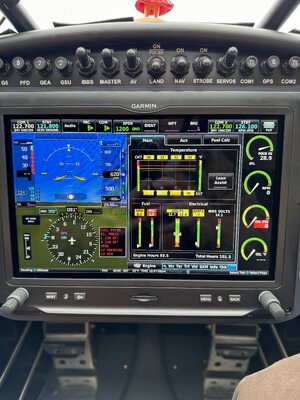
I think from the video you were looking at the SP O2 and Oxygen, the yellow is Terrain inhibit. I usually do that if I’m landing at non charted spots as it bitches at me.
 
I think from the video you were looking at the SP O2 and Oxygen, the yellow is Terrain inhibit. I usually do that if I’m landing at non charted spots as it bitches at me.
To make others aware, I saw the alerts in @Cubonaut875's G3X and inquired what they were. I think he'd like to know how to get the red alerts to go away per our video comment dialog. It seems he has something enabled on the config side that's not detected as a device? Correct me if I'm wrong John, was just curious what those were showing.
 
If red alerts are displayed that do not require immediate flight crew action then the whole purpose of the alerting system is defeated.

If one gets used to having red alerts when no action is required then it becomes much easier to miss those alerts for which immediate action is required.
 
Last edited:
To make others aware, I saw the alerts in @Cubonaut875's G3X and inquired what they were. I think he's like to know how to get the red alerts to go away per our video comment dialog. It seems he has something enabled on the config side that's not detected as a device? Correct me if I'm wrong John, was just curious what those were showing.
Very early on I talked to Pete about those alerts and he said that without an O2 system, that those would just stay that way. I accepted that as fact and just treat it like any label on the screen. Now it dawns on me that I might be able to go into the Config Sys menu and get rid of that on the screen. The terrain alert inhibited is a good one actually. I'll report back on that.
 
Very early on I talked to Pete about those alerts and he said that without an O2 system, that those would just stay that way. I accepted that as fact and just treat it like any label on the screen.

I'm guessing you have the Aithre system so I looked at the installation manual which can be reached from his page -


If the file name encodes a date then that manual seems to have been written before Garmin introduced conditional alerting.

In a well integrated system it should have been possible for the Aithre system to tell G3X Touch that the oxygen system was intentionally not in use. I see no provision for doing that. However, it should be easy to inhibit alerting based on altitude.

One possible scheme would be to inhibit all oxygen system alerting below 5,000 ft; allow only amber alerting between 5,000 ft and 10,000 ft; allow amber and red alerting above 10,000 ft. If you planned to use the oxygen system you should have checked it before engine start using PRICE checklist or similar. Conditional alerting would also allow you to enable the alerts before engine start and still keep the altitude inhibits while in flight.

Setting up conditional alerting is a bit fiddly the first time you try but it gets easier when you play with it a bit. The first step is to decide how you want it to work.

If you don't actually have an oxygen system it should be possible to delete the oxygen system scales and then the alerts will go away.
 
Last edited:
I have Aithre in my plane, that's not what he's seeing, that could be CO not SPO2. Someone setup SPO2 in his config for some reason and I'm surprised Pete didn't give better or more guidance. I think if you just go to the Config side into the Engine & Airframe I think it is (GEA 24 area) and review the sensors you'll find it and can turn it off.

I adjusted my terrain warnings in the G3X and don't get them based on my params, I don't have to inhibit it. This is also a bad practice as if you're going to depend on it you'll forget you turned it off as you'll be used to the warning and it won't get your attention. I turned off Terrain warnings in the GNC 355. As we land on grass strips, it will always think we're on a collision course with the ground. You just need to take another look and experiment with your settings and you'll get it dialed in like I did. If you need me to check mine for something let me know and I can review next time at the plane. Keep in mind it's Africa hot right now so I'm staying in!
 
The alerts were -

Alerts.PNG


They indicate low O2 saturation (pulse oximeter) low oxygen pressure (bottle sensor)

I'm sure they can be made to go away but I'd need a screen capture of the GEA 24 sensor inputs and the actual equipment fit to know what needs to be deleted or revised.
 

Latest resources

Back
Top Bottom