Welcome to Flightinfo.com

  • Register now and join the discussion
  • Friendliest aviation Ccmmunity on the web
  • Modern site for PC's, Phones, Tablets - no 3rd party apps required
  • Ask questions, help others, promote aviation
  • Share the passion for aviation
  • Invite everyone to Flightinfo.com and let's have fun

MOD Upgrading the ignition backup battery in a Carbon Cub FX-3

  • Thread starter Thread starter Neal
  • Start date Start date
  • Watchers Watchers 5

Welcome to Flightinfo.com

  • Register now and join the discussion
  • Modern secure site, no 3rd party apps required
  • Invite your friends
  • Share the passion of aviation
  • Friendliest aviation community on the web
CB and fuses should be sized to protect the wiring not the equipment at the end of the wire. You can't increase the CB and fuse rating without considering whether the wire is rated for the increased current.

I don't know what blocking diode CubCrafters uses but the 90SQ030 diode shown in the LSE ignition schematic is rated at 9 A.
 
I may put a 15A fuse in place of the 10A as that's behind the panel and not something I can reset in flight. I believe that limit is only affected by charging and not discharging of the battery for demands such as Light Speed. It's really just to protect the incoming current (charge). The breaker I can reset but again should not be affected by charging but only in use activities?

Am I thinking this through correctly as my only concern of going over 10A is during charge.
 
The 10 A fuse is in circuit for charging and discharging. The 10 A CB and the blocking diode only pass current when charging.

When I was concerned about the charge rate of the AGM I devised and tested a simple current limiter but I never fitted it to the aircraft. I stopped doing in flight testing as I found the 10 second run-up test was a good indicator of battery condition.

The limiter was based on the characteristics of tungsten filaments. They have low resistance when cold and high resistance when hot. In series between source and load they act as a current limiting device. More current, filament gets hotter, resistance goes up, voltage drop increases, current goes down.

My limiter used a car tungsten brake light bulb. I do not know if such a limiter would be compatible with the LiFePO4 BMS but it could easily be tested on the bench and I doubt it could harm the battery.
 
Has anyone checked the specs for max charge rate of the IBBS 3AH battery or the EBBS? Good info to know before diving into this mod. I hope to test mine today with a ground run.

@Cactus Charlie can you post the electrical schematic of the ignition backup circuit showing the charge path so I can see what you mention about going through the breaker, Light Speed, etc.? Just want to have it here in this discussion for educational purposes of anyone considering changing the factory setup.

Thanks!
 
Has anyone checked the specs for max charge rate of the IBBS 3AH battery

Yes, I did as part of the research of my plan to replace the AGM with a 3 AH IBBS.

"Pin 5 provides charging and bus voltage sensing for the IBBS unit and must be connected to an aircraft power bus. When the voltage on pin 5 falls below about 11 volts the system automatically transfers the load current on the output pins to the internal back-up battery source. Pin 5 maximum current draw is 2.5 amps during charging."
 
I hate electrical, it's that one thing that can insidiously bite you and takes careful planning and design. It bit me two years ago when upgrading my landing lights and blowing out the flaky wig-wag controller and took me months to get confidence I wasn't going to be Haley's comet cub edition. I'm happy to report that didn't happen and so far so good with the ground run post install completion of the EarthX backup battery in use for my ignition backup.

My plan today was to use male spades to connect to CubCrafters female spades used to connect to the PowerSonic battery to make reverting as easy as possible. As we all know that use the PowerSonic, the spades are narrow so sure enough I didn't have a compatible mate. I realized the wires coming in are coming down from the top and there is plenty of wire to reach the terminals on the EarthX without having to add wire. I cut the zip ties in the loom and pulled out the wire for the ignition backup battery which is interesting, the core is positive, the shield is the negative. I cut off the spades and installed ring terminals and heat shrunk the connection for additional security. I mistakenly loosened the wrong part on the EarthX which is the part the bolt goes into but I was lucky to get that resecured as I thought the day was done and I'd have to send the battery back for repair. I installed the pig tail, normal wires, and used a washer as the pig tail has quite a large hole in its terminal. I was surprised the pig tail I bought was shorter than the one for the starter battery but it will work out fine as it tucks under the panel near the 12V adapter and USB ports. I added electrical tape over the terminals as I don't like exposed terminals on the battery. Getting the battery in with wires connected was a tight fit but it worked. I used 3M dual lock (stronger than velcro) to secure the battery, it will be interesting trying to remove it someday as this stuff is strong.
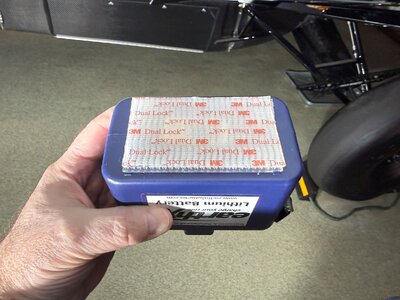
dual-lock-bottom.jpg

I'm so paranoid with this stuff, even with all switches off I thought I smelled smoke, I thought I saw smoke, I'm checking everything with a flashlight, haha...just paranoid as can be!! :) That's okay, I respect this electrical stuff and am being extra cautious obviously concerned with the potential 15A input with 10A CB/Fuses. Oh...I did pull the inline fuse while connecting the battery leads, and yes, it's 10A.

I turned on MASTER and the voltage showed and matched my voltmeter test of 13.3V. I wanted to use the multimeter during the engine run but it has a 10A max so I didn't connect for fear of blowing its fuse which I did years ago when testing solar in my RV and learned this lesson.

Time for the ground run, all checks good, so far.

Engine cranked fine and AMPS only got up to around +20 but immediately came down to around 14, then 11, etc. Charge voltage showed 13.7 on the ignition backup (14.0 on the starter) and with ignition backup on the voltage dropped to around 13.4. No breakers or fuses popped, engine ran fine as you can see in the video if desired. I'll also attach the G3X log file if anyone wants to review it.

earthx-ignbu.jpg

What is of interest and I'll be paying attention to this is the max charge voltage of the ignition backup circuit. I did charge my EarthX backup battery after receiving it to ensure it is charged when put into use but that was a month or so ago, if not more. But nothing has been connected to it. What I'm curious is what voltage is actually the charge voltage on the ignition backup circuit. If 13.7 is the max then this could be the reason the PowerSonic's never proved to be a good battery. An AGM battery needs to bulk charge in the mid 14's for voltage. As someone pointed out that it appears it's just getting a constant float voltage, this is the reason the ignition backup battery is never healthy. This is also why I installed a pigtail on my EarthX so I can charge and maintain it properly. I'm curious what others see as max charge voltage on their ignition backup circuit.

The last thing I need to do is update the ignition backup battery params in the G3X config which I'll match my EarthX starter battery numbers. I need to review those anyways, I want to make some adjustments to alerts.

A few pics showing the install and the pigtail which tucks up under the panel.

install-final.jpg


pigtail.jpg

I'll fly with the right forward panel removed for a while and make sure all is good before reinstalling that panel. I'll do a ground charge as well to make sure that works as expected. Overall, it's going to be nice having a strong battery with 4 AH capacity and 6 year life. It was not an easy mod nor one I'd recommend to all as you need to have a good understanding of the ramifications. I think if there was a way to improve the charging profile of the PowerSonic it would be a viable solution but something is just wrong in the electrical design it seems for charging that battery. But I'm on expert so I defer to those that know more.

I welcome any feedback, opinions, suggestions for improvement, or if I need an intervention :)


Attachments

Neil - Following this topic with interest. I know the builder of 40DT (also my builder) and he's been working on a more robust backup solution as well.

Jim

ps - Installed a whelen taxi light via your CNC'd mount the other day. Fantastic!
 
What I'm curious is what voltage is actually the charge voltage on the ignition backup circuit. If 13.7 is the max then this could be the reason the PowerSonic's never proved to be a good battery. An AGM battery needs to bulk charge in the mid 14's for voltage. As someone pointed out that it appears it's just getting a constant float voltage, this is the reason the ignition backup battery is never healthy.

The AGM charge voltage is MAIN bus volts less the diode drop. On my aircraft that's about 14.1 V which is enough to ensure full charge. I do not believe the short life of the AGM batteries is caused by the available charging voltage.

I turned on MASTER and the voltage showed and matched my voltmeter test of 13.3V. I wanted to use the multimeter during the engine run but it has a 10A max so I didn't connect for fear of blowing its fuse which I did years ago when testing solar in my RV and learned this lesson.

You'd rather risk blowing the blocking diode than the meter fuse?

I'm concerned that you did not do the bench tests that I suggested. If this battery does pull more than 10 A when charging after use it could completely disable your emergency ignition system by blowing the battery fuse.
 
I'm concerned that you did not do the bench tests that I suggested. If this battery does pull more than 10 A when charging after use it could completely disable your emergency ignition system by blowing the battery fuse.
Please provide the tests you suggest that I missed. Yes, I agree, if the 10A fuse blows the b/u ignition is offline. Air abort and investigate. I am stocking my spares kit with extra fuses both 10A and 15A. Obviously this scenario is an overcharge condition and not a loss of ignition, alternator, or starter battery sources for the ignition. Exceeding 10A is my main concern, I did not see it in this test i.e. no breaker pop or fuse blown. I believe your test is an extended use of the b/u ignition battery to try and demand a higher charge rate?
 
I welcome any feedback, opinions, suggestions for improvement, or if I need an intervention :)
Great post, @Neal!
I know the builder of 40DT (also my builder) and he's been working on a more robust backup solution as well.
I'm interested in a more robust backup system as well. Something more similar to that in the X/NXCub electrical system which uses a TCW IBBS. @Cactus Charlie may also be pondering a more robust set-up, but he points out that his ability to procrastinate is unusually high (HA!). Any chance you could get your builder to join the forum and share his thinking? We'd all be very appreciative.
 
Please provide the tests you suggest that I missed.

Perhaps I composed then deleted. Can't scroll up through the thread to check.

A bench test would require a load than pulls about 1.3 A and a 14 V power supply capable of sourcing a least 15 A.

You would discharge the battery using the load for multiple tests of increasing duration. After each of those tests you would charge the battery and record the charging current.

That would give some data on what charge current you would expect after in flight usage. You could then use the data to decide whether there needed to be changes to wire size, CB rating, diode current rating, or battery fuse.
 
That would give some data on what charge current you would expect after in flight usage.
If I used it in flight I would not be terminating use. I would be landing with it on. After that obviously there will be a investigation as to why I needed b/u ignition power and I'd also likely use my pigtail connection and charger to ensure a full charge of the battery for next use. The only "risk" scenario I see is a long term of non use just like the starter battery drawing a high charge rate. I will see what I can do to discharge the battery for a higher demand charge rate. I'm not convinced the ignition backup circuit pushes current the same as the starter battery.

I will test what I can, use the voltmeter, and report back any results.
 

Latest resources

Back
Top Bottom





