Welcome to Flightinfo.com

  • Register now and join the discussion
  • Friendliest aviation Ccmmunity on the web
  • Modern site for PC's, Phones, Tablets - no 3rd party apps required
  • Ask questions, help others, promote aviation
  • Share the passion for aviation
  • Invite everyone to Flightinfo.com and let's have fun

Choosing an ignition backup battery for an electronic ignition piston aircraft engine

  • Thread starter Thread starter Neal
  • Start date Start date
  • Watchers Watchers 5

Welcome to Flightinfo.com

  • Register now and join the discussion
  • Modern secure site, no 3rd party apps required
  • Invite your friends
  • Share the passion of aviation
  • Friendliest aviation community on the web
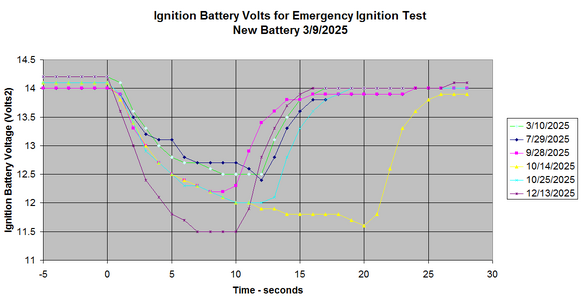
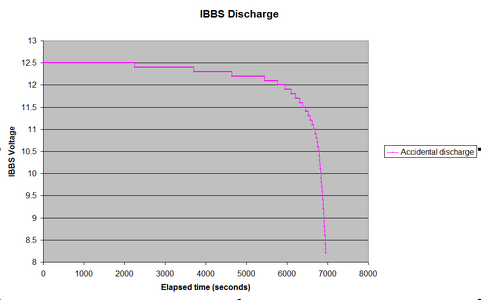
The voltage plot may be misleading. Voltage sampling started when the load was connected. There is no record of the unloaded battery voltage.

This was the original battery fitted by CubCrafters and the aircraft first flew May 2020. As I have said before I change the ignition battery on condition and test it at runup.

This battery looked very good when in-flight tested but had significantly deteriorated since then. I have all the test data but I'm not going to dig it out now.

Here is in flight test data (ignore the Amps legend that plot was removed):

in flight ign test.PNG
 
No need to go back for anything. Was just an observation. Most of us only see the charge voltage and don’t know the actual state of the battery. Last night I showed 12.5 prior to start. 13.7 with engine running. Drain down to 12.1 during right ignition backup test and I waited to see where it would stabilize. Realizing plane has been sitting for two weeks.
 
Here is the history for that battery. Just had to open the file and capture the image -

PS-1221S test history.PNG
 
Slightly adjacent (but related) question. @Neal was swapping your main battery for the EarthX a fairly easy install? What model battery did you choose?
 
Slightly adjacent (but related) question. @Neal was swapping your main battery for the EarthX a fairly easy install? What model battery did you choose?
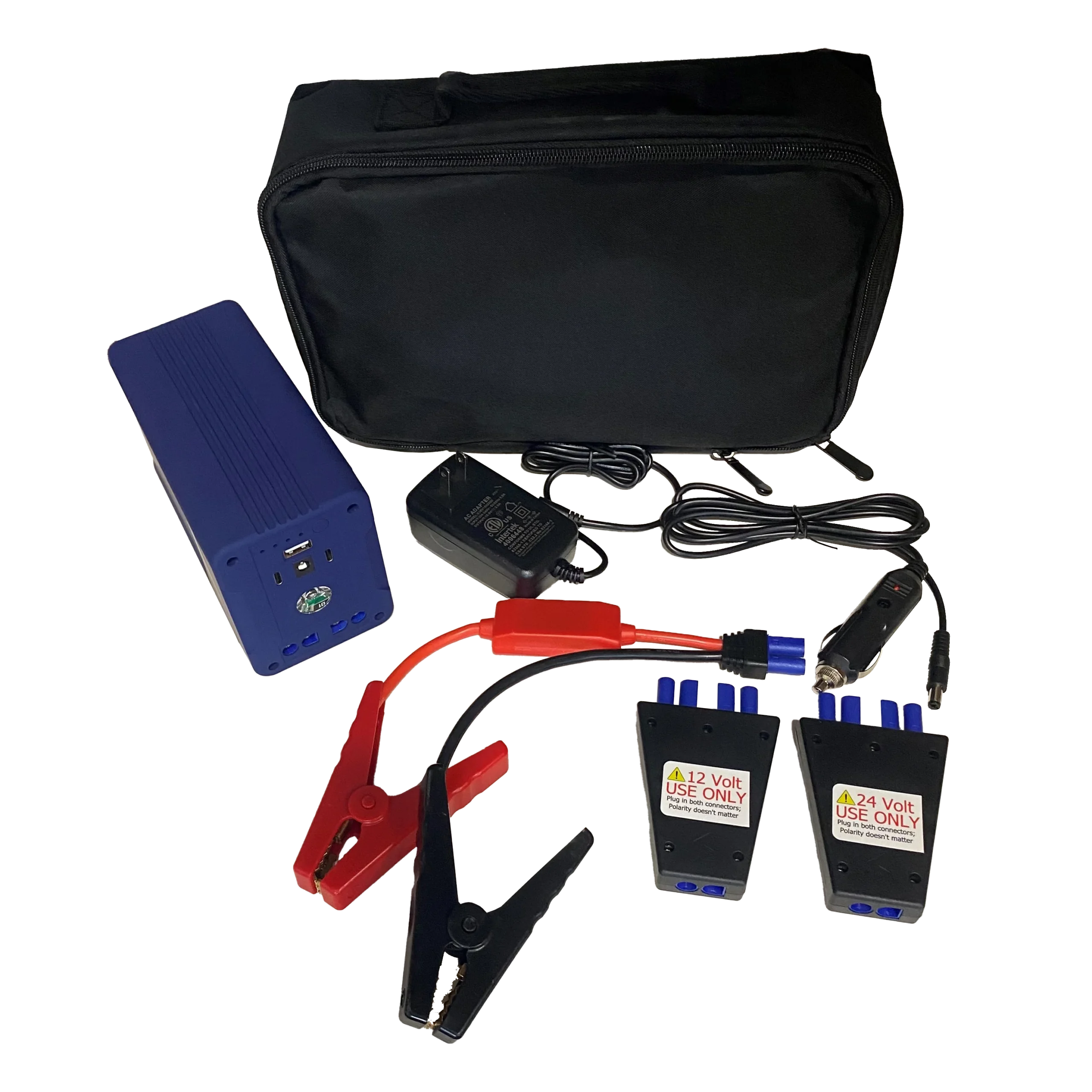
Yes. I went with the ETX-90 non vented (from memory). I have a post here if you search on EarthX. EarthX now sells an adapter that connects to the lugs to make it easier to attach wires which I recently bought with the backup battery for future use. The hardest thing with the starter battery no matter the type is the tight space.

If I did it over again I’d consider a vented option and just run a silicone tube that connects to a fitting on the inspection plate near the aft right fuel sump. It wouldn’t be hard to fish that tube I don’t think.
 
That sounds better. I’m on my phone at the moment. One of the other members mentioned the ETX-1200. I’d measure and see the highest capacity that fits.
 
I'm back at the computer, here is my thread on the EarthX I installed. Feel free to add to the thread as you wish as it's more fitting than this one.

 
Using the ETX 1200 is the way to go - it fits with little Room to spare but will definitely help if you have an alternator failure
The EarthX ETX series batteries are optimized for peak current rather than energy storage capacity. The ETX 1200 has about 20 Ah (at 10 A draw) compared to the ETX 900, which is about 15.6 Ah at a similar current draw. So, only a 28% improvement in capacity as compared to the 50% increase in CCA (cold crank amps).

There is also the ETX 1600 battery, which is 32 Ah capacity (twice the ETX 900), but it is slightly wider, so I will have to measure the space under the seat...

I think that updating the IBBS 3 Ah to an EBBS 8 Ah might be a better option to add 5 Ah while removing the current weak spot of the AGM ignition backup battery.
 
I'm seriously considering swapping out my EarthX ETX900VNT with an ETX1200. Issue is that EarthX does not make the 1200 with a vent option. In my CCX-2300 where the battery is installed in the aft avionics bay, is this really an issue? There is plenty of room back there and the cabin of the plane is not sealed / insulated. @Neal also confirming that you use the ETX900VNT vented battery in your plane, correct?
 
Please don't enable me. I want to upgrade to the 1200 but don't see that it's necessary haha. The struggle is real! I'm waiting for my 900 to show even the slightest degradation so I can break out the credit card :)

No, I do NOT use the vented version and I'm not concerned. Master off, windows open, if something were to occur. It's probably a requirement for certified aircraft for worst case scenarios. I'd certainly love to know if there are any stories of these having a thermal runaway and smoke issue. If a vented version were available I'd consider it only because that's what some install and think running a vent tube wouldn't be difficult.

The risk is probably the same as any other electrical fire scenario that would produce smoke. Installed properly, risk should be minimal.

I'm all on board in making my plane the safest I can make it and that involves improving batteries backing the electronic ignition our engine relies on. I see nothing wrong with the design by CubCrafters, I just see opportunity to make it better.
 
On final to KDVT yesterday and I was surprised (understatement) by a "VOLTAGE!" aural alert. My immediate reaction was that it could not be possible for me to have had an alternator failure and discharged the main battery without being aware of a problem. It took a few seconds to get past the denial and find the problem.

I had turned on emergency ignition instead of the fuel pump. My 2 AH AGM was close to replacement time and, since the alternator was actually charging, my conditional alerting was using the "on-charge" voltage levels. Problem resolved by turning off the emergency ignition and turning on the fuel pump.

My recollection is that I heard "Voltage" then "Ignition Volts" but the data log does not show two separate CAS alerts.

It got my attention.
 
Ignition battery drain peaked at 1.4 A at 2170 rpm and 11.5 V.
 
Wouldn’t it be nice if the backup ignition switch was just an arming feature? In fact how about removing it and the ignition fails over to the backup battery when voltage drops below a level? Sense alternator and starter battery voltage. When insufficient then engage backup ignition. Make the switch an override only. It should never need to be touched.
 

Latest resources

Back
Top Bottom