Welcome to Flightinfo.com

  • Register now and join the discussion
  • Friendliest aviation Ccmmunity on the web
  • Modern site for PC's, Phones, Tablets - no 3rd party apps required
  • Ask questions, help others, promote aviation
  • Share the passion for aviation
  • Invite everyone to Flightinfo.com and let's have fun

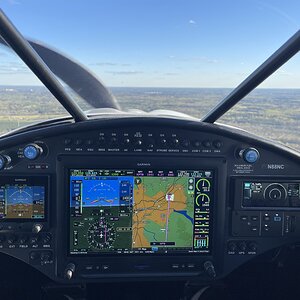
Flying from the right seat

Welcome to Flightinfo.com

  • Register now and join the discussion
  • Modern secure site, no 3rd party apps required
  • Invite your friends
  • Share the passion of aviation
  • Friendliest aviation community on the web

fourierman

New member
Joined
May 2, 2004
Posts
1
Well I've only flown from the right seat about 8 hours now -- landings are ok but still having some issues with steep turns in particular.

Whats the deal with steep turns (to the right) being so hard from the right seat? is it just me?

Also, does anyone have any general info regarding how to adjust altitude/airspeed/DG, etc. with the angle/view from the right? (ie will it appear higher/lower than actual ? )

I'm currently working on my commerical but plan on doing the CFI and commercial checkrides about the same time if I'm ready by that point

Thanks
 
That's just the change in sight picture. Parallax - the apparent change in perception of an object when viewed from a different angle (I think that's the right way to describe it). I was asked about that on my CFI ride.

And for me, steep turns to the left seem to be harder from the right seat...can't help you there. Maybe I'm the weird one....Sorry.
 
My steep turns are wierd like that too. My right one is a little harder to maintain altitude but I can nail the left one to the T.
 
Its all the same.
 
Adjustments for parallax depend on how deep the instrument is, away from the pointer.

The newer instruments don't have much depth in the face.

Adjusting for parallax and getting used to the different sight picture will get better over time.

You don't have to 'teach' for your CFI checkride; you just have to be able to fly from the right seat and talk while you fly; just make sure you can do that and you'll be fine.
 
Sam Snead said:
You don't have to 'teach' for your CFI checkride; you just have to be able to fly from the right seat and talk while you fly; just make sure you can do that and you'll be fine.
Thats not true, look at the PTS, you must teach and talk through everything from the right side, I know that is exactly what my examiner made me do.
 
I went flying yesterday to review myself for the CFII check ride and my turns to the left were nailed but the right I was losing about 100 ft. It just feels diferent I think. Different sensations that are unusual to the body in regards to a left turn.
 
siucavflight said:
Thats not true, look at the PTS, you must teach and talk through everything from the right side, I know that is exactly what my examiner made me do.

Uh.... do you think you are actually "teaching" the examiner anything?

Teaching implies learning, which is defined as a change in behavior.

Just prove you can talk and fly, and the teaching is inferred from that.

The examiner may ask you "student" questions but answering questions in itself is not teaching.

Why would you be telling me to look at the PTS? This board is about real world solutions to PTS problems, not the other way around. If all a person needed was the PTS, the discussions on training would all be moot.

Fooey on you.
 
RichardRambone said:
I went flying yesterday to review myself for the CFII check ride and my turns to the left were nailed but the right I was losing about 100 ft. It just feels diferent I think. Different sensations that are unusual to the body in regards to a left turn.

OK, time to weigh in with my grandiose theory.

From the left seat, the horizon appears to rise (ie nose down) in left turn and vice versa to the right. Due to the "space" between the cowling and the horizon. the "space" is a major pitch attitude mechanism

From the right seat, vice versa. The "pitch" attitude mechanism is reversed and is unusual to the beginning right seater.

I want you all to know that it took this grandiose instructor candidate about 10 hours to land straight enough for safety's sake, during CFI training. My first few attempts were cockeyed disasters.
 
Don't worry about the right side flying, all it takes is just a little practice, and look straight through you window instead of your nose cone and prop. If you are a right handed person, you will find flying on the right side is much easier than left side. Still remember when I was a CFI, the only difficulty I had was to learn to read instruments from any angle.
 
ubpilot said:
If you are a right handed person, you will find flying on the right side is much easier than left side.
Very true. Im a lefty and felt well adapted to the left side. When I started flying right seat, I was all tore up. But like everyone else says, it just takes time. I make myself fly left seat every now and then just to keep the skills polished on both sides. Same for tandem, switch it up whenever you can.
 
after 4 years in the right seat im most comfortable there. as far as losing altitude,airspeed, etc.......suck it up and nail it.
 
The two most important instruments to a CFI in my opinion are the Airspeed and TC. I could never understand why they are the 2 that are farthest away from the right seat.
 
It definately takes some getting used to. For the first couple of hours in the right seat for me, I was loosing 200+ ft in a steep turn. It was the most frustrating thing. All of a sudden, it just snapped. Don't worry, you will get the hang of it.
 
I'd have to agree with ubpilot. After about 4 or 5 hours in the right seat I realized that the key was to give up using the cowling as a reference and instead just look straight ahead. (Directly in front of you, not towards the center of the plane.) After I figured that out, everything from steep turns to landings just worked.

I think using the cowling as reference might work for early students, but after a while it's a crutch. What about those planes (multis?) where there is no cowling reference.

my $.02.
 
Last edited:
Okay, but is it really that hard to land from the right seat?
I'm thinking of doing some training for my wife. To get her comfortable, I thought I would put her where she can see all the controls. That would mean that I have to fly from the right seat, and is it really that difficult?
 
sky37d said:
Okay, but is it really that hard to land from the right seat?
I'm thinking of doing some training for my wife. To get her comfortable, I thought I would put her where she can see all the controls. That would mean that I have to fly from the right seat, and is it really that difficult?


You are an MEI and have never sat in the right seat? How does that work?
 
Because it's my plane. And MEI means Multi Engine, Instrument. No CFI associated with that.
Back to the question. How hard is it to fly from the right seat. I was thinking of just going out and doing some take off's and landings, by my self.
 
sky37d said:
Because it's my plane. And MEI means Multi Engine, Instrument. No CFI associated with that.
Back to the question. How hard is it to fly from the right seat. I was thinking of just going out and doing some take off's and landings, by my self.

My apologizes. When I see MEI I automatically think Multi Engine Instructor. Flying from the right seat is kind of like learning how to drive from the right side. You have to get comfortable moving your viewpoints and holding the yoke with your right hand and using your left hand for other operations. When I started my CFI training I found myself taxing left of the centerline and landing on the left side of the runway. I would suggest going up a couple times with someone sitting left seat just incase. After a couple landings you should get the hang of it. I had the hardest time with cross wind landings from the right seat
 
Thanks.
I have wondered about that.
I have a couple of friends who fly the same kind of plane I do, and perhaps I can get one of them to fly with me. I live on a 2700' grass strip. Take off's are no problem, most of the time, but landing is always a challenge.

Okay, next question.
Can I be a CFI ME, or would I have to learn to fly 172's again?
 
sky37d said:
Thanks.
I have wondered about that.
I have a couple of friends who fly the same kind of plane I do, and perhaps I can get one of them to fly with me. I live on a 2700' grass strip. Take off's are no problem, most of the time, but landing is always a challenge.

Okay, next question.
Can I be a CFI ME, or would I have to learn to fly 172's again?


To be an MEI there would be no reason for you to fly a ASEL.
 
No requirement that you do an initial CFI in a single-engine airplane. Out of curiosity, are you only planning on teaching multi students? Or are you planning on doing the single engine CFI later? No big deal, just curious why you don't want the single engine CFI.
 
Something that has worked for myself and students in the past on steep turns was to look out the window about 30-45 degrees ahead of the airplane, scanning the horizon and using the peripheral vision to make control inputs. Seems strange, but just give it a try on a few and see if it works. One advantage was it did keep you from overshooting your roll out point as you would see it coming rather than say "there it goes."
 
sky37d said:
Because it's my plane. And MEI means Multi Engine, Instrument. No CFI associated with that.
....just a quick tip. In the rest of the aviation world, in normal aviationspeak, MEI means Mult-Engine Instructor.
 
sky37d said:
Okay, next question.
Can I be a CFI ME, or would I have to learn to fly 172's again?
Yes, you can be an MEI only. You don't ever have to get into a single again.
 
flyer172r said:
No requirement that you do an initial CFI in a single-engine airplane. Out of curiosity, are you only planning on teaching multi students? Or are you planning on doing the single engine CFI later? No big deal, just curious why you don't want the single engine CFI.

No, not single engine. I don't own one, and don't want to fly one. I suppose if I was interested in furthering my aviation career, I would do that. However, I don't have an aviation career, and can't afford one.

Also, I have fond and not so fond memories of my various instructors, when I was taking initial lessons. I think that if I were to do any instructing, it would be a the ME level, since the first time some kid tried to kill me, I'd probably open the door, and throw him out.

A guy I knew was taking lessons at the same time, and during stall training, managed to put the 152 into a spin. The instructor recovered, they went back to do stalls again, and he spun it again.

I figure the ME students have gotten over that kind of stuff. And during ME training, the instructor demonstrates VMC, but never actually do it, and don't let the student come close to it. Much safer.
 
sky37d said:
I figure the ME students have gotten over that kind of stuff. And during ME training, the instructor demonstrates VMC, but never actually do it, and don't let the student come close to it. Much safer.

Well, acutually, you're right...I mean if you put a "most" in there..most of them have gotten over it. But that's the thrill of instructing. You never know what he/she will do. Shop around. Lots of horrow stories of wrong engine cuts, wrong and strong rudder inputs...they're still kids, ya know.
And you really do have to get to Vmc in training. It's on the PTS, ya know.
 
nosehair said:
Well, acutually, you're right...I mean if you put a "most" in there..most of them have gotten over it. But that's the thrill of instructing. You never know what he/she will do. Shop around. Lots of horrow stories of wrong engine cuts, wrong and strong rudder inputs...they're still kids, ya know.
And you really do have to get to Vmc in training. It's on the PTS, ya know.
A long time ago, the DPE would actually cut the engine, not just zero thrust. One of the stories I heard, when I was doing my ME, was that the DPE cut an engine right after take off, and the examinee cut and feathered the other one. :eek:

No survivors.

Oh, you are right about VMC, I forgot, but it's done at lots of altitude, so plenty of room for recovery.
 
Okay,
The REAL reason I want to fly from the right seat is this.
I do a goodly amount of formation flying, and we have tons of still pictures, air to air. Lately, we've started doing video. Normally a 2 ship formation, and I am not normally the lead, so my videographer sits behind me. Not the best location, since the strut gets in the way.
If I can fly, land, and fly formation from the right seat, then my videographer can sit in the left seat and get much better shots. In the first video we made, none of my guys stuff made it into the video.
This is what I mean.
http://video.google.com/videoplay?docid=-5663049676668412789&q=cessna+skymaster
 

Latest resources

Back
Top Bottom