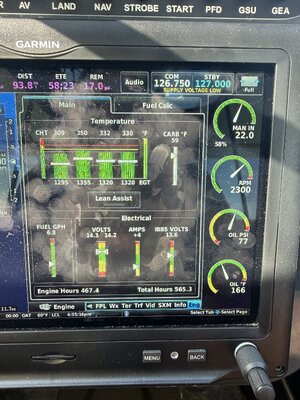
Just asked Chat GPT for an opinion:
“
That message usually means the COM radio itself is seeing undervoltage at its power input, not just that the airplane’s displayed bus voltage looks a little low. Garmin’s docs define “SUPPLY VOLTAGE LOW” as supply voltage being too low and say to verify the input voltage meets the installation minimum. On the related GTR COM test page, Garmin says LO VOLT indicates the radio input voltage is low, and that this can be caused by a low battery condition or a wiring fault preventing the radio from receiving proper voltage. Garmin also notes the radio may reduce transmit power or stop transmitting completely depending on how low the voltage gets.
So in practice, the common triggers are:
- Engine start / cranking voltage sag
- Low battery or weak charging system
- Voltage drop on the radio’s specific power feed even when the main bus still looks normal
- High-resistance wiring issue: loose pin, bad ground, tired breaker/switch, corroded connection, partially damaged wire
- A problem that shows up especially during transmit, because transmit load pulls more current and exposes a weak feed more easily. Garmin notes transmit current is about 3 amps under ideal load, while receive current is much lower.
Looking at your photo, the airplane is showing about 14.2–14.3 V on the electrical page, so if that warning was present at the same moment, I’d be suspicious of a radio-specific feed/drop issue more than a whole-aircraft low-voltage event. In other words, the bus may be fine while the radio still sees low voltage at its connector because of wiring or connection loss between the bus and the COM. That’s an inference from the display plus Garmin’s description of the alert as a radio-input-voltage problem.
Best troubleshooting order:
- See when it happens
- only during start
- only during transmit
- randomly in flight
- only with certain loads on
- Check voltage at the COM radio connector
- compare bus voltage vs. radio input voltage
- especially during transmit and during any event that reproduces the alert
- Inspect the power and ground path
- breaker/fuse
- switch/avionics bus feed
- ground lug
- connector pins/crimps
- any splices
- Check charging system health
- alternator output
- regulator behavior
- battery condition
If it only flashes during engine start, that is often just cranking sag. If it appears in normal flight with 14+ volts showing, that points much more toward wiring, connection, or local feed issues to the radio.
If you want, I can help you narrow this down based on your exact setup, like whether your COM is a GTR 200/200B, GTR 20, or GTR 205, and whether the alert happens only on transmit or also in cruise.”
And this is what GROK says:
“The “SUPPLY VOLTAGE LOW” message in the G3X comm field is a COM radio error message (from the connected Garmin GTR 20, GTR 200, or similar remote-mounted VHF comm transceiver that the G3X controls).19
It is triggered when the supply (input) voltage measured at the COM radio itself drops below the minimum operating threshold specified in the radio’s installation manual (typically around 9–11 V for these 14 V systems, though the exact cutoff is defined in the manual). The G3X Pilot’s Guide lists it explicitly under COM error messages:
SUPPLY VOLTAGE LOW
Supply voltage is too low.
Action: Verify supply voltage meets minimum requirement identified in installation manual. Contact Garmin for service if message persists.26
Why it appears even when the main bus voltage looks normal (14.3 / 14.2 V in your photo)
The G3X engine page shows the main aircraft bus voltage, but the COM radio monitors its own dedicated power feed. Common causes include:
- Voltage drop in the wiring specific to the COM radio (most frequent real-world trigger reported in G3X/GTR installations): loose power/ground connections, poor crimps, corrosion, undersized wire, or a bad ground point at the radio rack.
- Transient dips (e.g., during engine start, high electrical loads, or with lithium batteries like EarthX that can sag under load).
- Issues with the power distribution (circuit breaker, relay, or GAD 27 if installed for voltage stabilization).
- Rarely, a problem inside the radio itself.
Note: Related GTR alerts you might also see are “REDUCED TX POWER – LOW VOLTS” or “INPUT VOLTAGE TOO LOW” (transmit power is automatically reduced or disabled to protect the radio).30
What to check
- Measure voltage directly at the COM radio’s power pins (or at the rack) while the warning is active — compare it to the main bus voltage.
- Inspect/clean/tighten the COM power and ground connections.
- Check for any recent work on the avionics bus or wiring.
- If it’s intermittent or only appears under certain loads, monitor the COM voltage during flight.
If the voltage at the radio is confirmed good but the message persists, contact Garmin (
g3xpert@garmin.com is the usual route for G3X owners) as it could be an internal radio issue.
This is a very common alert in G3X-equipped experimental/light aircraft and is almost always fixed by addressing the power feed to the radio rather than a system-wide electrical problem.”